Why Are All Snowflakes Six-sided?
With the first day of winter just around the corner, snowflakes will soon be fluttering down and drifting about, creating a winter wonderland. While a snow-blanketed village can be a beautiful site, the shape of each singular snowflake can be a wonder of complex symmetry and beauty.
Every snowflake is hexagonal in shape. Why is that? The patterned or symmetrical design of snowflakes reflects the bonding structure of the water molecules making up the ice crystals in the flake. Hydrogen atoms in one water molecule will bond to oxygen atoms in other water molecules, creating a hexagonal lattice. In this diagram, the red balls represent oxygen atoms, while the grey bars represent hydrogen atoms.
 |
| Courtesy of SnowCrystals.com |
The hexagonal lattice will repeat over and over as more water vapor freezes to the structure, causing the flake to grow both in size and complexity, all the while remaining in a hexagonal form.
 |
| Courtesy of NOAA |
Why are all snowflakes unique?
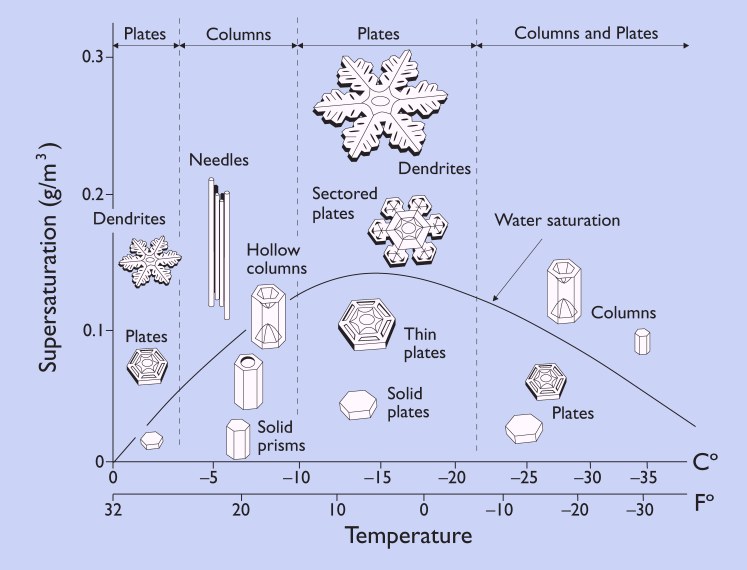
Water vapor continually freezes onto the arms of the hexagon, expanding it symmetrically. Although each snowflake grows symmetrically, no two snowflakes are identical. The shape of each snowflake is highly dependent on the atmospheric conditions surrounding it. The formations are extremely sensitive to temperature and humidity. For example, snowflakes forming in high water saturation, or humidity, with temperatures around 5 degrees Fahrenheit will form the archetypal flat, complex plate-shaped flakes. Other variations can cause snowflakes to form as hollow columns, needles, prisms, and more.
 |
| Courtesy of SnowCrystals.com |
 |
| Courtesy of SnowCrystals.com |
No comments:
Post a Comment